A quiet room, a tidy desk, a smartphone turned off. Even after creating a perfect environment, the child sits idly, or slumps over and sleeps within 30 minutes.
Parents often feel frustrated, lamenting a “lack of will,” but in reality, a riot is brewing within the child’s brain.
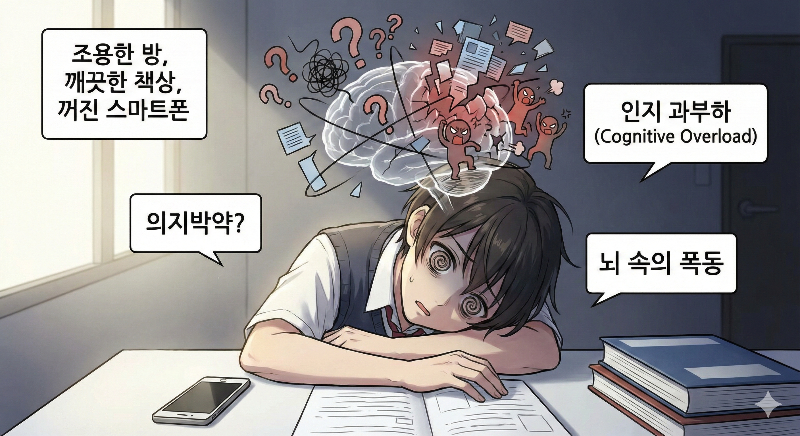
Even without external distractions, an incorrect learning approach can generate immense disorder (entropy) within the brain. This state, where the brain’s processing capacity is pushed beyond its limits, is precisely ‘Cognitive Overload.’
1. Cognitive Load Theory: The Brain’s Funnel Limit
Our brain, particularly the ‘Working Memory’ utilized during immediate study, has a very limited capacity. Neuroscientists suggest that humans can process only 4 to 7 ‘chunks’ of information at any one time.
The Brain is Like a Narrow Funnel
Learning is the process of bringing external knowledge into working memory, processing it, and then storing it in the vast warehouse of long-term memory. However, high-entropy learning is akin to shoving raw, unorganized information all at once into this narrow working memory channel.
Differences in Information Delivery
💡 Low-Entropy State (Order)
Handing over a well-organized bundle of documents is easily received and processed. (Low load)
🌪️ High-Entropy State (Disorder)
If you throw 100 loose A4 sheets, the recipient will be so busy picking them up and organizing them that they won’t even be able to read the content. (Cognitive load occurs)
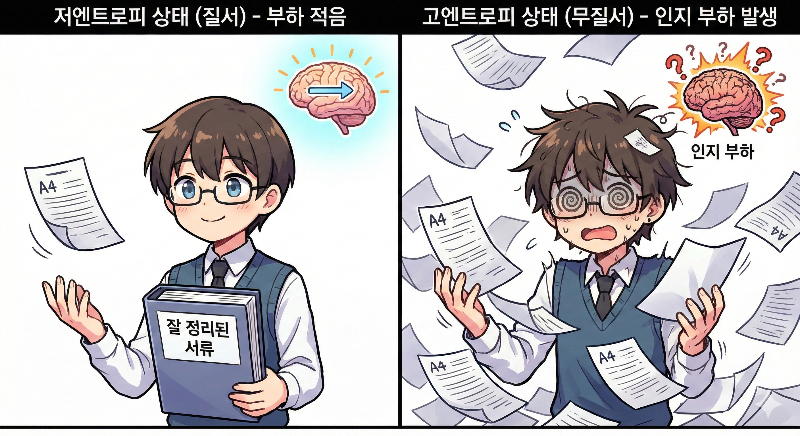
This is why attempts to underline everything, thinking “this is important and that is important,” and blindly memorize them fail. If information is not structured, the brain perceives it as ‘noise’ rather than ‘knowledge,’ and it undergoes a shutdown due to overload.
2. The Illusion of “Knowing It All”: Metacognitive Error
The most dangerous state of entropy is ‘not knowing what you don’t know.’
The Trap of Fluency Illusion
When attending a lecture or watching an online course, children often nod their heads. This is because they are passively observing knowledge that the instructor has well-organized (in a low-entropy state). The brain, experiencing information flow smoothly, feels comfortable and mistakenly perceives this as ‘something I know.’
This is called the ‘Fluency Illusion.’
What is Fluency Illusion?
The phenomenon where one feels they understand a lecturer’s explanation or a textbook easily, but then cannot even begin to solve problems on their own.

However, when they try to solve problems independently, they find themselves unable to. This is because it was the instructor’s knowledge, not their own. The information that entered their mind floats aimlessly, unable to find its proper place.
Real Knowledge vs. Fake Knowledge
| Category | State | Characteristics |
|---|---|---|
| Real Knowledge | Low Entropy | Indexed, can be retrieved at any time |
| Fake Knowledge | High Entropy | Buried in a warehouse, unknown whereabouts |
What is Metacognition?
The ability to know what one knows and does not know. Metacognition fails to function because the mind is in such disarray that one cannot even assess its current state.
Metacognition Check-up Questions
Ask yourself:
- Can I explain this content without looking at the book?
- Do I know why this formula is used?
- Can I pinpoint exactly which parts are difficult?
- Do I understand it well enough to teach it to a friend?
If you answer “no” to these questions, it’s not yet real learning.
3. Symptoms: Burnout Caused by High Entropy
In physics, maintaining or attempting to control a disordered state requires the most energy. The same applies to learning.
The Moment the Brain Blows a Fuse
Clinging to an unorganized mind consumes an immense amount of brain energy. When disorder reaches its peak, and energy consumption becomes unbearable, the brain autonomously blows a fuse.
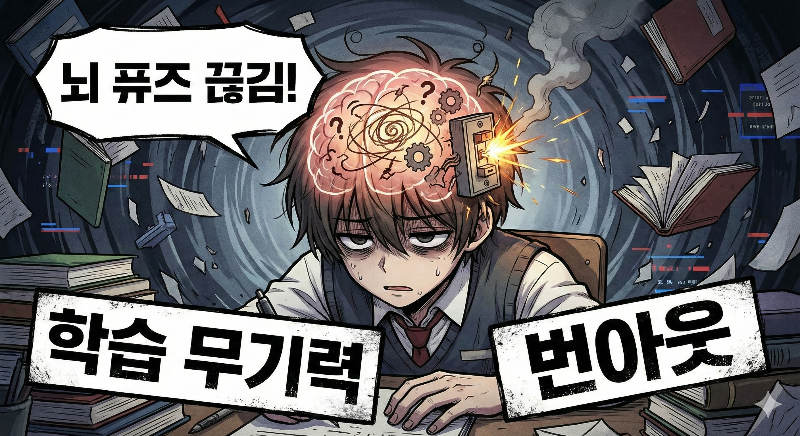
This is precisely ‘academic helplessness’ and ‘burnout.’
The Brain’s Cry
“My mind is such a mess right now that I have no more energy to process information!”
Typical Symptoms of a High-Entropy Learner
- Chronic Fatigue: Feeling tired just by sitting at the desk
- Avoidance: Constantly postponing the start of studying
- Decreased Concentration: Difficulty concentrating for even 5 minutes
- Anxiety and Restlessness: Feeling overwhelmed by tasks, yet unable to do anything
Key Summary
| Concept | Description | Solution Direction |
|---|---|---|
| Cognitive Overload | Exceeding working memory capacity | Chunking information |
| Fluency Illusion | The brain’s lie of knowing | Explaining it yourself, retrieval practice |
| Academic Helplessness | Shutdown due to energy depletion | Reducing entropy and restarting |